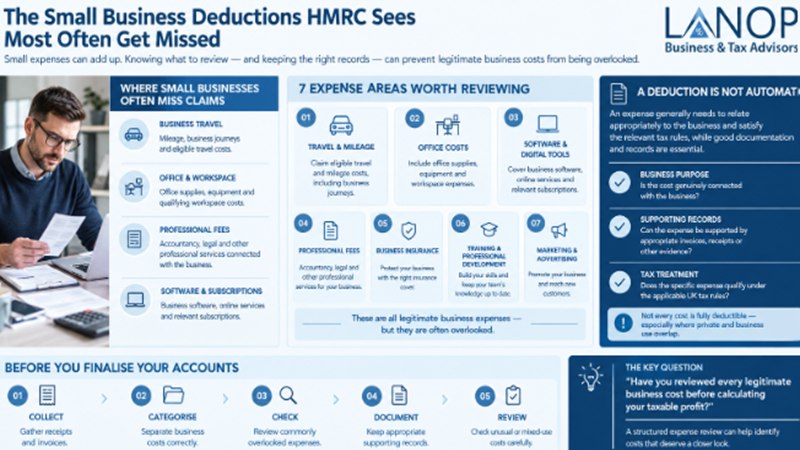
Ask most business owners about tax deductions, and they’ll list the obvious ones: equipment, travel, stationery. Those are easy to spot because you write a check or swipe a card and think, “that’s a business expense.” The ones that vanish are smaller and quieter, a card payment for cloud storage, a bank fee, half a phone bill that’s mostly work. When people finally sit down and review their finances properly, many turn to accountants for small businesses to check whether these everyday costs slipped through before the tax return went in.
This isn’t another list of allowable expenses copied from a government page. It’s a look at where deductions actually go missing, how to separate a business cost from a private one, and what to do if you’ve already filed a return without one.
Why Do Small Businesses Miss Expenses in the First Place?
Small recurring costs don’t feel important. A £12 subscription looks trivial next to a £2,000 van repair, but run it for a year and it’s £144, and most people have three or four of these ticking away quietly in the background.
There’s also the blur between personal and business spending. Your phone gets used for both. So does your broadband, maybe your car. Mixed use doesn’t mean you claim nothing, though plenty of people assume it does. It means working out what share genuinely belongs to the business.
Then there’s the line itself. HMRC judges a claim on business purpose, the rules that apply, and whether you can back it up with evidence. Most missed expenses aren’t complicated. They’re just found too late, usually after the return has already gone in.
The Expenses That Are Easiest to Miss
Software and digital tools sit near the top. Accounting software, project-management tools, cloud storage, website hosting, domain renewals, they all get paid automatically, so there’s rarely a receipt sitting in an inbox to jog your memory. Scroll through your card statement before you file. You’ll probably spot something.
Bank and payment charges come next: business bank fees, card transaction charges, payment-processing costs. Nobody actively “buys” a bank fee, which is exactly why it slips past.
Professional fees and memberships get missed for a different reason. Accountancy costs, bookkeeping, professional indemnity insurance, trade body memberships, these feel like unavoidable overhead rather than something worth reviewing each year.
Marketing and business development costs cause their own confusion. Advertising, website costs, promotional material and relevant training all count, but only when the purpose is genuinely commercial rather than mostly personal benefit dressed up as a business cost.
Home-working costs deserve more than a passing mention. You can use simplified expenses, a flat rate tied to hours worked, or calculate the actual business share of heating, electricity and broadband. The flat rate isn’t automatic, and it isn’t always the better deal. Someone working 60 hours a month from a spare room might land a bigger deduction by working out the real cost than by taking the standard rate.
Travel, mileage and parking bring their own grey area. Business mileage, public transport, parking and qualifying travel costs are all fair game. The confusion usually sits between business travel and ordinary commuting, since driving to see a client isn’t the same as driving to your usual workplace.
Equipment and technology need a bit more thought too. A laptop, a monitor, specialist tools, not every expensive purchase gets deducted the way a box of printer paper would. Some count as capital expenditure instead, and the treatment can shift depending on your accounting method.
And then there’s the expense paid personally. You bought something on your own card because the business account wasn’t handy. That doesn’t disqualify the claim. What matters is business purpose, evidence, and recording it properly so it doesn’t get lost between two sets of accounts.
The Grey Areas That Cause the Most Confusion
An expense isn’t automatically allowable just because it helps the business somehow. Circumstances and private use still matter.
| Type of use | How it’s treated |
| Business-only | Potentially fully claimable |
| Mixed personal and business | Work out and claim the business share |
| Private | Generally not allowable |
Notice there’s no fixed percentage here, whatever a forum thread might promise.
Clothing trips people up constantly. A suit bought for client meetings isn’t allowable, because you could wear it anywhere. Genuine protective clothing or a uniform sits in a different category.
Meals cause similar trouble. Lunch with a client counts as entertainment, and entertainment isn’t an ordinary deduction. Food while you’re actually travelling for business can qualify as subsistence instead. The distinction comes down to the purpose of the trip versus the purpose of the meal.
Training only counts when it develops your existing trade. A course that launches you into something entirely new is a different story.
Don’t Confuse These Three Tax Rules
The £1,000 trading allowance and actual expenses aren’t two pots you dip into together. You pick one, whichever leaves you better off.
| Method | How it works |
| Trading allowance | £1,000 tax-free, used instead of claiming any expenses |
| Simplified expenses | Set flat rates for certain costs, such as home-working hours or a vehicle |
| Actual costs | Your real, calculated business costs |
Neither simplified expenses nor actual costs wins by default. It depends on your numbers.
A running cost isn’t the same as buying a business asset, either. One typically gets ordinary expense treatment. The other might fall under capital allowances, and your accounting method affects which applies.
What If You Already Missed an Expense?
Finding an old receipt after you’ve filed doesn’t mean the tax relief has disappeared. What happens next depends on the tax year involved and whether that return can still be amended.
Start with the evidence: the receipt, invoice, bank statement or mileage record. Then work out which tax year it actually belongs to, because you can’t just fold an old expense into this year’s figures. Check whether the return still falls within the amendment window, hold onto whatever records you’ve found, and get advice before you touch anything if the treatment isn’t obvious.
A 10-Minute Expense Audit
Before you file, run through this:
- Bank statements: bank charges, processing fees, software, subscriptions, insurance, professional fees, training, marketing.
- Household spending: broadband, phone, electricity, heating, Council Tax, relevant home-working costs.
- Travel: mileage, public transport, parking, accommodation.
- Equipment: laptop, monitor, tools, printer.
- Personal spending: did you pay for anything business-related from your own account?
- Old returns: did you spot a legitimate expense after an earlier tax year had already been filed?
Common Mistakes Worth Avoiding
A surprising number of problems come from the same handful of habits: claiming personal spending as a business cost, claiming 100% of something with obvious private use baked in, treating every asset purchase like an ordinary expense, calling client entertainment a normal deduction, mixing the trading allowance with actual expenses, and filing an old cost under the wrong tax year.
Then there’s the big one: assuming a large expense creates a large refund. Claim £6,000 against £40,000 of income, and your taxable profit drops to £34,000. HMRC doesn’t hand you £6,000 back.
Frequently Asked Questions
What business expenses do small businesses most commonly miss?
Recurring digital costs, bank charges, and home-working costs sit at the top, mostly because they’re paid automatically rather than purchased with any real decision behind them. People also overlook anything split between personal and business use, like phones or broadband, simply because working out the split feels like a hassle. Going through card statements line by line usually turns up more than most expect.
How do I know if a mixed-use expense counts as a business cost?
Start by figuring out how much of the cost genuinely relates to business activity, whether that’s hours worked, floor space used, or mileage driven. The business portion can usually be claimed, while the personal share can’t, and there’s no single percentage that applies across every situation. What matters most is that your calculation is reasonable and you can explain how you got there.
Can I still claim an expense from a previous tax year that I forgot about?
It depends on how far back the expense goes and whether that year’s return can still be amended under current rules. The first step is pinning down the correct tax year rather than tacking the cost onto this year’s figures. From there, the right approach depends on the specifics, so it’s worth checking rather than assuming you’ve missed your chance.
Is buying a laptop or other equipment treated the same as an ordinary expense?
Not always. Equipment can fall under capital allowances rather than being deducted like a routine running cost, and the distinction often comes down to the value of the item and the accounting method you’re using. Some people overclaim here, others miss the relief entirely, so it’s worth getting the treatment right.
Why doesn’t a big expense always lead to a big tax refund?
An expense reduces the profit your tax gets calculated on, rather than landing back in your pocket as a direct refund. A £6,000 deduction against £40,000 of income brings your taxable profit down to £34,000, not your tax bill down by £6,000. This mix-up is common, and it tends to leave people expecting more from a claim than the numbers actually deliver.
Conclusion
The biggest missed deductions rarely involve clever tax tricks. They’re ordinary costs that happen every month, get paid automatically, sit mixed in with personal spending, or simply get forgotten before the return is prepared.
Review, identify, separate, document, claim correctly. For businesses with spending patterns that aren’t straightforward,Lanop Business & Tax Advisors can go through the records properly with you and flag what needs a closer look, the kind of review that’s genuinely worth having from accountants for small business before HMRC does it for you instead.