Choosing a spine specialist can feel overwhelming. Patients are often dealing with pain, numbness, weakness, limited movement, or frustration after months of trying to “just stretch it out” and hoping the spine magically joins the cooperation committee. A physician biography can help turn that uncertainty into a clearer first step.
Kamal Woods, MD, MBA, FAANS, is described by Vertrae® as a board-certified neurosurgeon, founder of Vertrae® and Vertrae® Surgery Center, and a specialist in degenerative spine conditions. His public profile includes combined orthopedic and neurosurgery spine fellowship training at Cedars-Sinai Medical Center, neurosurgery residency at Loma Linda University Medical Center, and an MBA from Johns Hopkins University. That combination of clinical training, spine specialization, and leadership experience helps define the care model associated with Vertrae®.
Who Is Dr. Kamal Woods?
Dr. Kamal Woods is a neurosurgeon and spine specialist whose work centers on helping patients understand and address spine-related problems. Vertrae® identifies him as MD, MBA, FAANS, board-certified in neurosurgery, and the founder of both Vertrae® and Vertrae® Surgery Center. His practice is based in Miamisburg, Ohio, serving patients seeking evaluation and treatment for spine conditions.
His bio matters because spine care is personal. A patient is not simply choosing a procedure or a medical office. They are choosing the physician who will explain imaging, evaluate symptoms, recommend treatment options, and help guide important decisions about pain, function, and quality of life.
A strong physician profile gives patients useful context. It answers questions about training, clinical focus, leadership, and care philosophy before the first appointment begins. That information can help patients feel more prepared and less lost in the alphabet soup of medical credentials.
What Training Shapes His Spine Care Approach?
Dr. Woods’ public biography highlights advanced training in both neurosurgery and spine care. His neurosurgery residency at Loma Linda University Medical Center provided the foundation for treating conditions involving the brain, spine, spinal cord, nerve roots, and related neurological structures. For spine patients, that matters because symptoms often involve nerve function as much as bone or disc structure.
His combined orthopedic and neurosurgery spine fellowship at Cedars-Sinai Medical Center adds another layer. Orthopedic spine training emphasizes structure, alignment, stability, and movement. Neurosurgical spine training emphasizes the spinal cord, nerve roots, and neurological function. Together, these perspectives can support a broader understanding of complex spine problems.
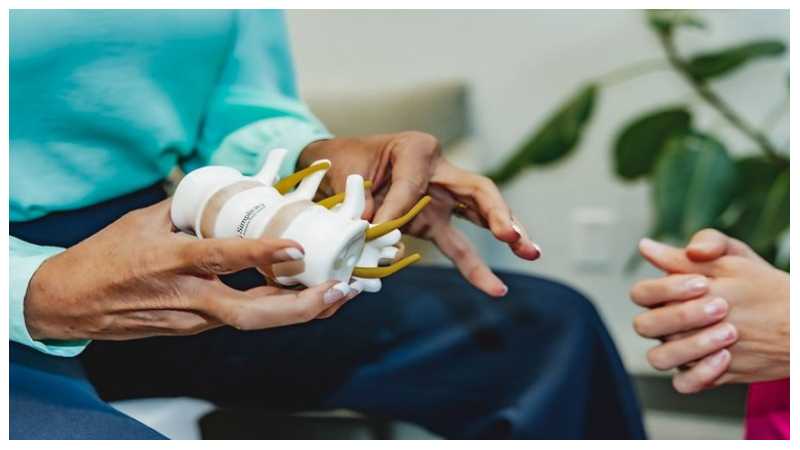
The spine is a busy neighborhood. Bones, discs, joints, ligaments, nerves, and muscles all share a tight space. When one structure causes trouble, symptoms may travel into the arms, legs, hands, or feet. Specialized training helps connect symptoms, imaging, anatomy, and patient goals into a more thoughtful treatment discussion.
Why Does Board Certification Matter?
Board certification is an important marker in a physician’s professional profile. Vertrae® identifies Dr. Woods as board-certified in neurosurgery through the American Board of Neurological Surgery. While no credential replaces a patient’s individual consultation, board certification gives patients a clearer sense of formal training, examination, and professional accountability within the specialty.
For spine care, this is especially relevant because decisions can be complex. Some patients may need conservative treatment. Others may need injections, physical therapy, monitoring, or surgical evaluation. A board-certified neurosurgeon brings specialty training to those decisions.
Patients should feel comfortable asking what their diagnosis means, how symptoms connect to imaging, what treatment options exist, and why one option may be recommended over another. A credentialed physician profile helps establish trust, but clear communication is what turns that trust into a useful care experience.
What Conditions Does His Bio Connect With?
Vertrae® describes Dr. Woods as focused on degenerative spine conditions, including herniated discs, spinal stenosis, degenerative disc disease, and sciatica. These conditions can affect movement, comfort, sleep, work, and daily independence.
A herniated disc may irritate or compress nearby nerves. Spinal stenosis can narrow the spaces where nerves travel. Degenerative disc disease may contribute to pain, stiffness, or instability. Sciatica often involves radiating pain that travels from the lower back into the leg. These problems may sound technical, but patients usually describe them in everyday terms: burning, shooting, aching, tingling, weakness, or “I cannot sit through dinner without shifting fifteen times.”
The value of a spine specialist is not just naming the condition. It is helping patients understand what the diagnosis means and what options may help. Some patients improve without surgery. Others may need more advanced treatment. The right path depends on symptoms, exam findings, imaging, health history, and personal goals.
For patients researching the physician and spine care model, Dr. Kamal Woods offers a starting point for learning about Vertrae® and its approach to spine health.
How Does His MBA Influence the Practice Model?
Dr. Woods’ MBA from Johns Hopkins University adds an important leadership dimension to his biography. Healthcare is not only about clinical skills. It also involves systems, communication, scheduling, patient education, care coordination, technology, and follow-up. A medical practice can have advanced services, but if patients feel confused by the process, the experience becomes harder than it needs to be.
Business education can support a more organized approach to care delivery. For Vertrae®, that may mean a practice model focused on moving patients through evaluation, diagnosis, nonsurgical treatment options, physical therapy, surgical planning when appropriate, and follow-up in a connected way.
In plain language, the MBA part of the bio suggests that Dr. Woods’ leadership is not only clinical. It also includes thinking about how care is structured. Patients benefit when the pathway feels easier to understand. Nobody wants spine care to feel like assembling furniture with missing instructions.
What Makes His Care Philosophy Patient-Centered?
Vertrae® public materials describe a patient-first philosophy and a focus on helping people return to activities they value. That philosophy matters because spine conditions affect real life, not just medical charts. One patient may want to return to work. Another may want to walk without leg pain. Another may want to sleep, travel, lift a grandchild, or get through the day without constant nerve symptoms.
Patient-centered spine care begins by listening. Imaging is important, but it is not the whole story. A scan can show anatomy, but the patient explains the impact. A thoughtful care conversation should connect both.
This approach can also include reviewing nonsurgical options before surgery when appropriate. Vertrae® describes complete spine care that includes office-based evaluation, diagnosis, nonsurgical treatment, in-house physical therapy, and advanced surgical options for patients who need them. That range matters because good spine care is not one-size-fits-all.
How Do Innovation and Experience Fit Into His Bio?
Dr. Woods’ biography is closely tied to modern spine care. Vertrae® materials reference minimally invasive spine surgery, robotic-assisted techniques, motion-preserving options, spinal fusion, disc replacement, spinal cord stimulation, conservative care, and spinal injections. These terms can sound high-tech, but the practical idea is simple: treatment should be matched carefully to the patient and condition.
Innovation is not valuable just because it is new. It is valuable when it supports better planning, precision, recovery goals, or patient understanding. A skilled physician evaluates whether an approach is appropriate, not merely whether it is available.
Experience also matters. Vertrae® states that Dr. Woods has performed thousands of spine procedures. That public statement provides context for patients who want to understand the level of practical exposure behind the physician profile. In spine care, experience, judgment, technology, and communication all need to work together.
For people reviewing spine care options and the physician’s background, Dr. Kamal Woods provides information about the practice and care philosophy.
A Physician Bio That Helps Patients Ask Better Questions
The biography of Dr. Kamal Woods gives patients more than a list of titles. It offers a framework for understanding his medical training, specialty focus, leadership role, and approach to patient care. The key details are his neurosurgery background, combined orthopedic and neurosurgery spine fellowship, board certification, MBA, and role as founder of Vertrae® and Vertrae® Surgery Center.
For patients, that information can make the care journey feel more approachable. It can also inspire better questions. What is causing the symptoms? Do the imaging findings match the pain pattern? What nonsurgical options are available? When is surgery considered? What does recovery look like? How does the recommended plan support daily life?
A physician bio cannot replace a consultation, but it can help patients understand who is guiding the conversation. In spine care, that understanding is important. Patients deserve advanced expertise, clear explanations, and a plan that recognizes both the medical condition and the person living with it.